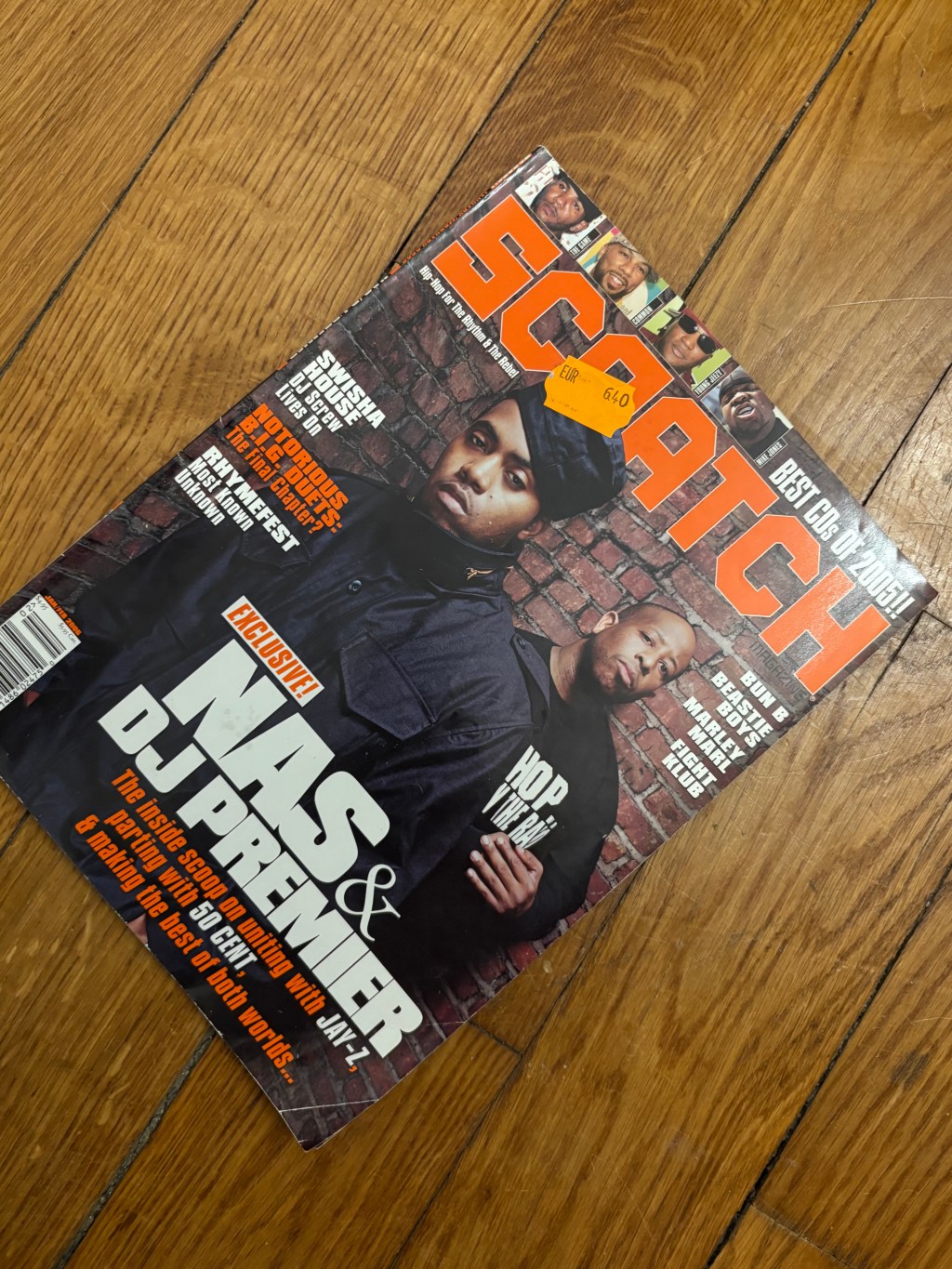
This is the first entry in a monthly English series, to analyze and celebrate hip-hop journalism (a genre that no longer exists) to pay homage to these publications that shaped me and also to give another lens on the moments that still define the music today. Sit Back Relax.
When I picked up Scratch Magazine in January 2006 with Nas and DJ Premier on the cover, I was convinced the album was finally coming. Their first collaboration dated back to 1994. On Illmatic, Premier produced three tracks : “N.Y. State of Mind,” “Memory Lane” and “Represent,” still my personal favorite. After Stillmatic in 2001, the two barely crossed paths again. Twenty years would pass before their first full collaborative album finally materialized.
Now let’s hop in the DeLorean, destination 2005. That year produced Kanye’s Late Registration, Common’s Be, The Mouse and the Mask by Danger Mouse and MF DOOM, and marked the rise of Young Jeezy and the whole Houston scene. At the same time, G-Unit (Tony Yayo, Game, GRODT soundtrack) dominated the industry, with 50 Cent releasing The Massacre, which sold 1.15 million copies in its first four days. Hip-hop was commercially unstoppable and culturally restless.
In 2005, where were Primo and Nas in their musical journey ? Gang Starr’s last album The Ownerz had already been out for two years. Premier had done collaborations with Blaq Poet, Big Shug, and also the gem “The Exorcist” for Little Vic, a track that I discovered on a DJ Whoo Kid mixtape. Primo was no longer considered “hot,” but he was obviously still a heavyweight, as shown on that Little Vic production. Nas, on his side, had a collaboration with Kelis, “We Major” with Kanye West on Late Registration, and above all ended of his war of words with Jay-Z.
This is the context in which Scratch Magazine places them together. The cover, shot by Clay Patrick McBride, is striking in its restraint: no concept, no spectacle, just two figures standing side by side. Inside, the magazine keeps them separate. Brian Coleman interviews DJ Premier and Jerry L. Barrow speaks with Nas. There is no cross-interview, no grand announcement : only proximity, and suggestion. In hindsight, that editorial choice says more than any headline could. The real cross-interview between the two giants would only happen twenty years later, on Joe Budden’s platform.
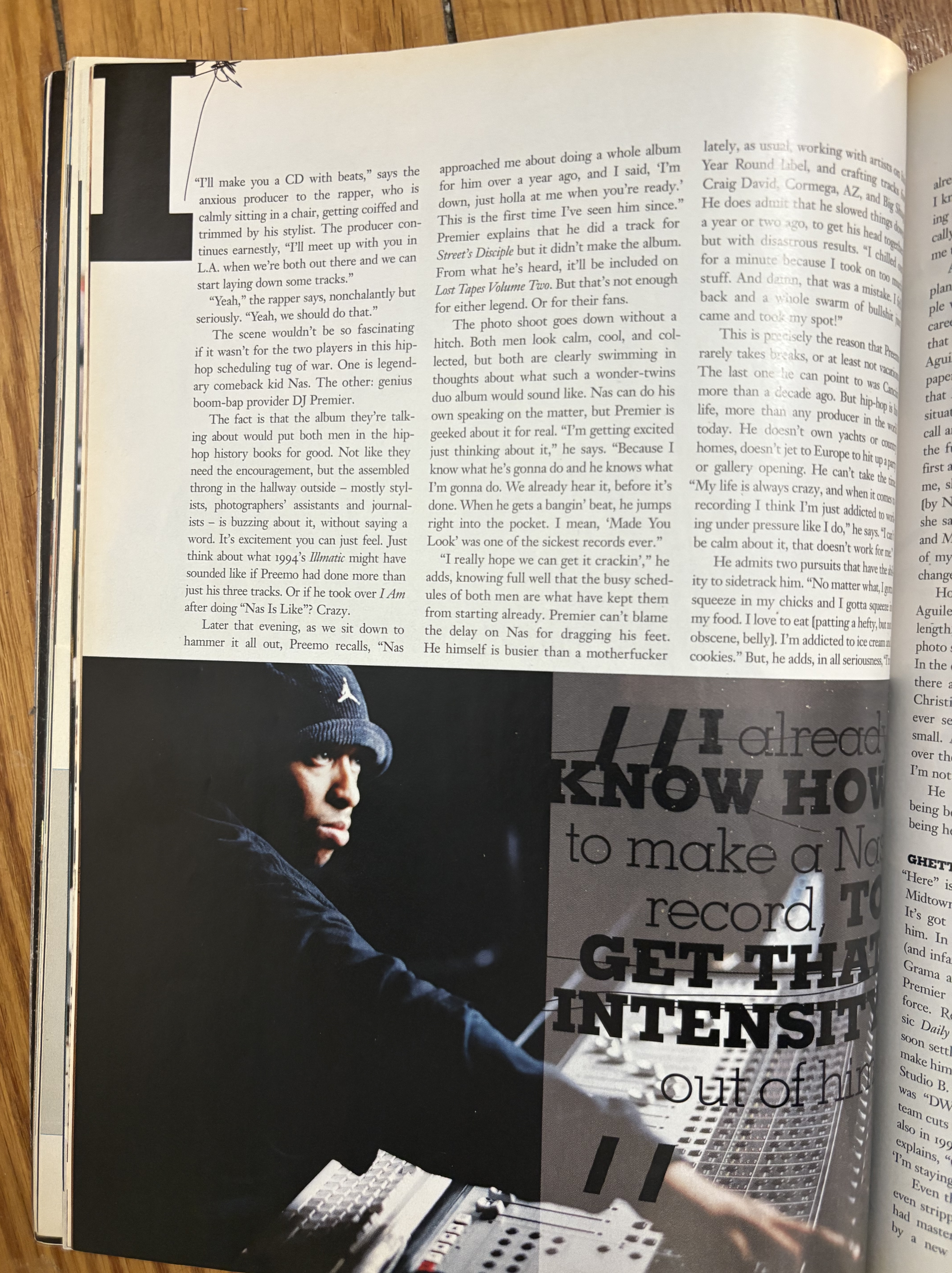
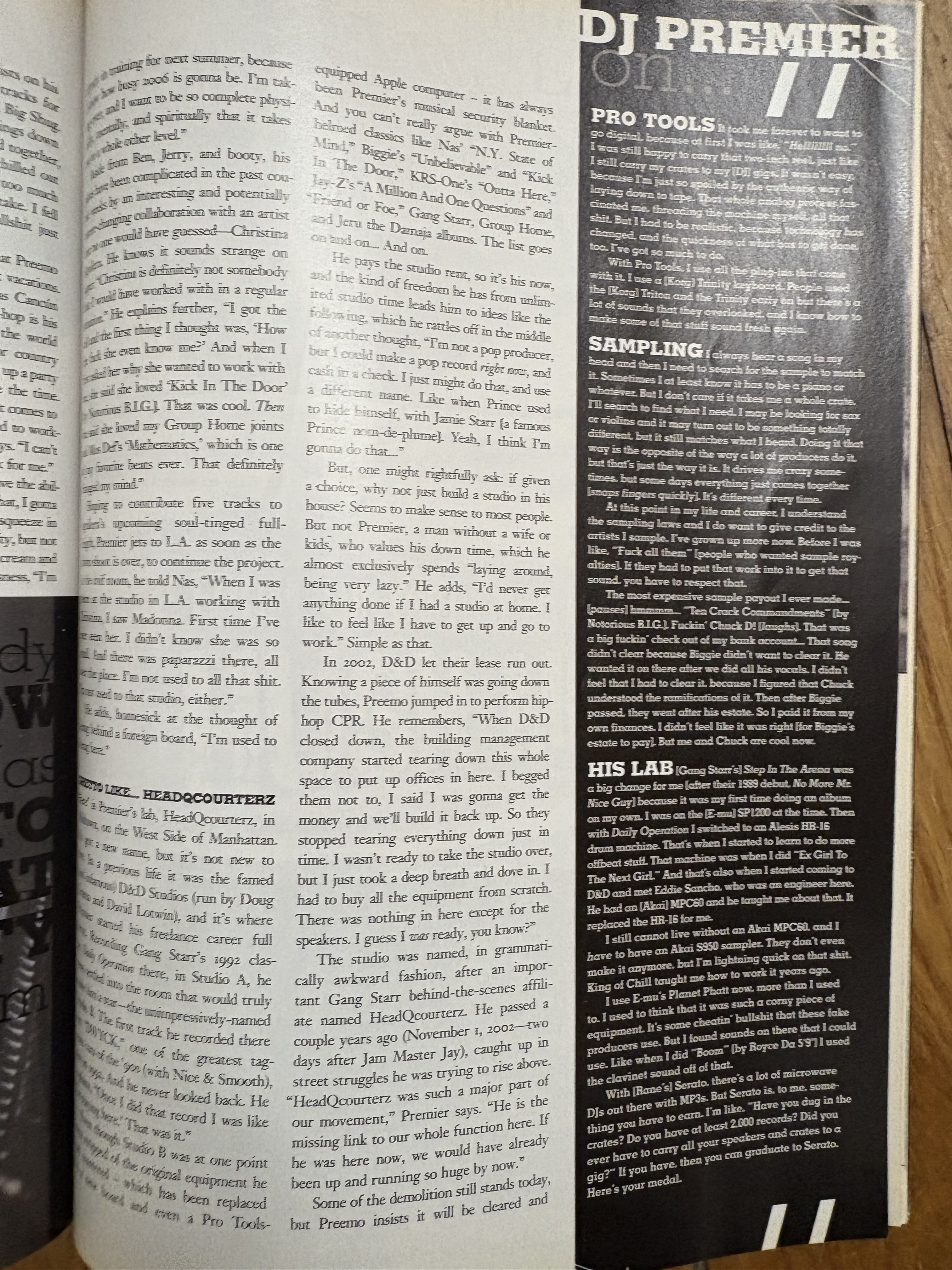
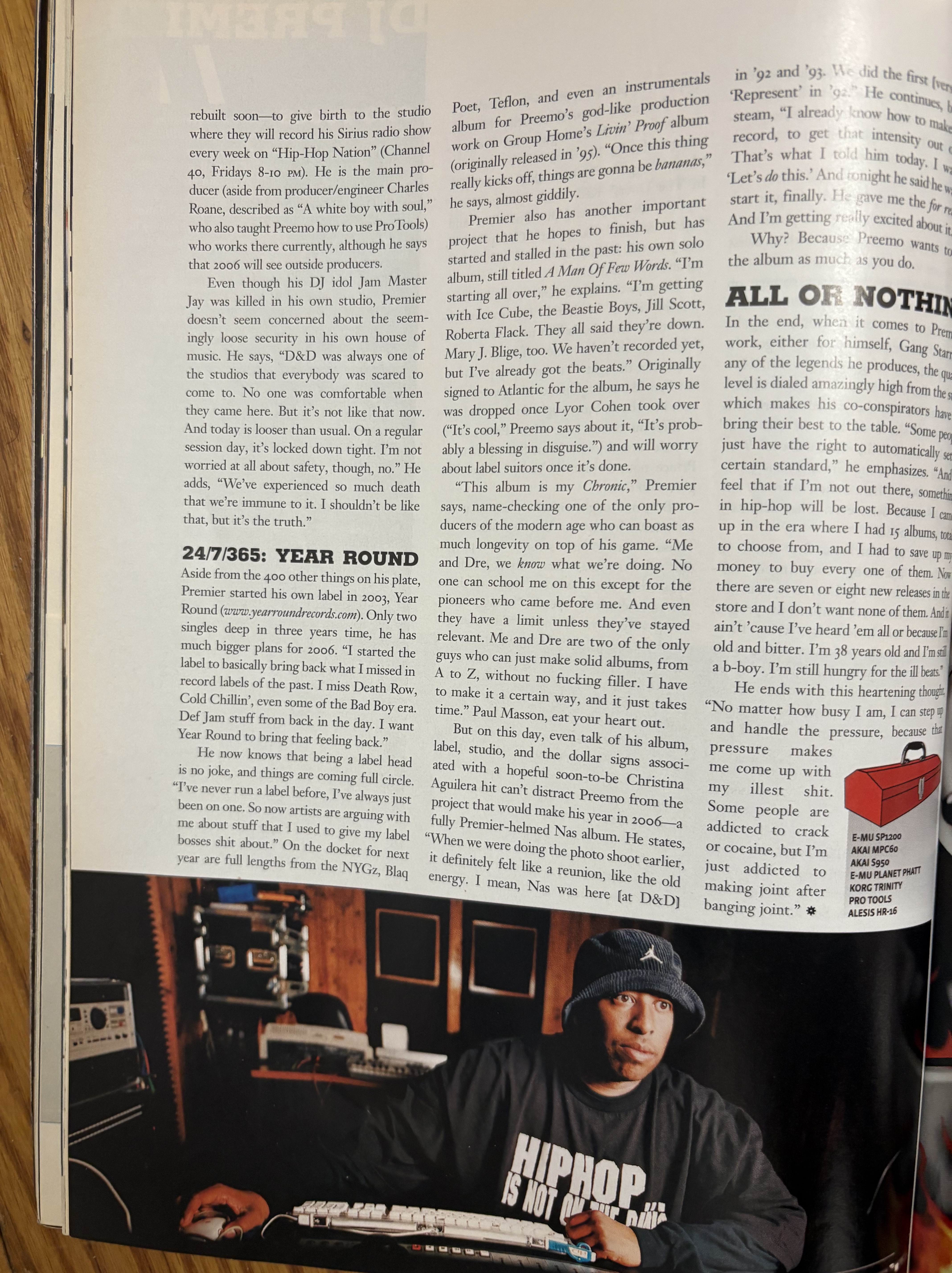
DJ Premier’s article written by Brian Coleman, opens with a simple line that now feels almost prophetic: “I’ll make you a CD with beats.” It is a very strong opening, that makes the reader dream. Pretty quickly, the writer explains that Premier is extremely busy. He is caught up between the creation of his label, Year Round Records and his collaborations with artists as different as Craig David and Big Shug. The journalist also notes that right after the shoot, Premier jumps on a plane to L.A. to work with Christina Aguilera. Today we know that he would end up being credited on five tracks of the album Back to Basics, which sold five million copies, and stands as an ambitious project for a – back then- pop star of that level.
But that’s not even the craziest part. Later on article we have a scoop Brian Coleman write « Premier also has another important project that he hopes to finish, but has started and stalled in the past: his own solo album, still titled A Man Of Few Words. “I’m starting all over,” he explains. “I’m getting with Ice Cube, the Beastie Boys, Jill Scott, Roberta Flack. They all said they’re down. Mary J. Blige, too. We haven’t recorded yet, but I’ve already got the beats”. Originally signed to Atlantic for the album, he says he was dropped once Lyor Cohen took over (“It’s cool,” Preemo says about it, “It’s probably a blessing in disguise.”) and will worry about label suitors once it’s done. » Where is Dame Dash ? We need him to yell at someone !
“This album is my Chronic,” Premier says, name-checking one of the only producers of the modern age who can boast as much longevity on top of his game. “Me and Dre, we know what we’re doing. No one can school me on this except for the pioneers who came before me. And even they have a limit unless they’ve stayed relevant. Me and Dre are two of the only guys who can just make solid albums, from A to Z, without no fucking filler. I have to make it a certain way, and it just takes time”.
Now that we’ve got the project with Nas, can we please have the « Man Of Few Words » project monsieur Premier ?
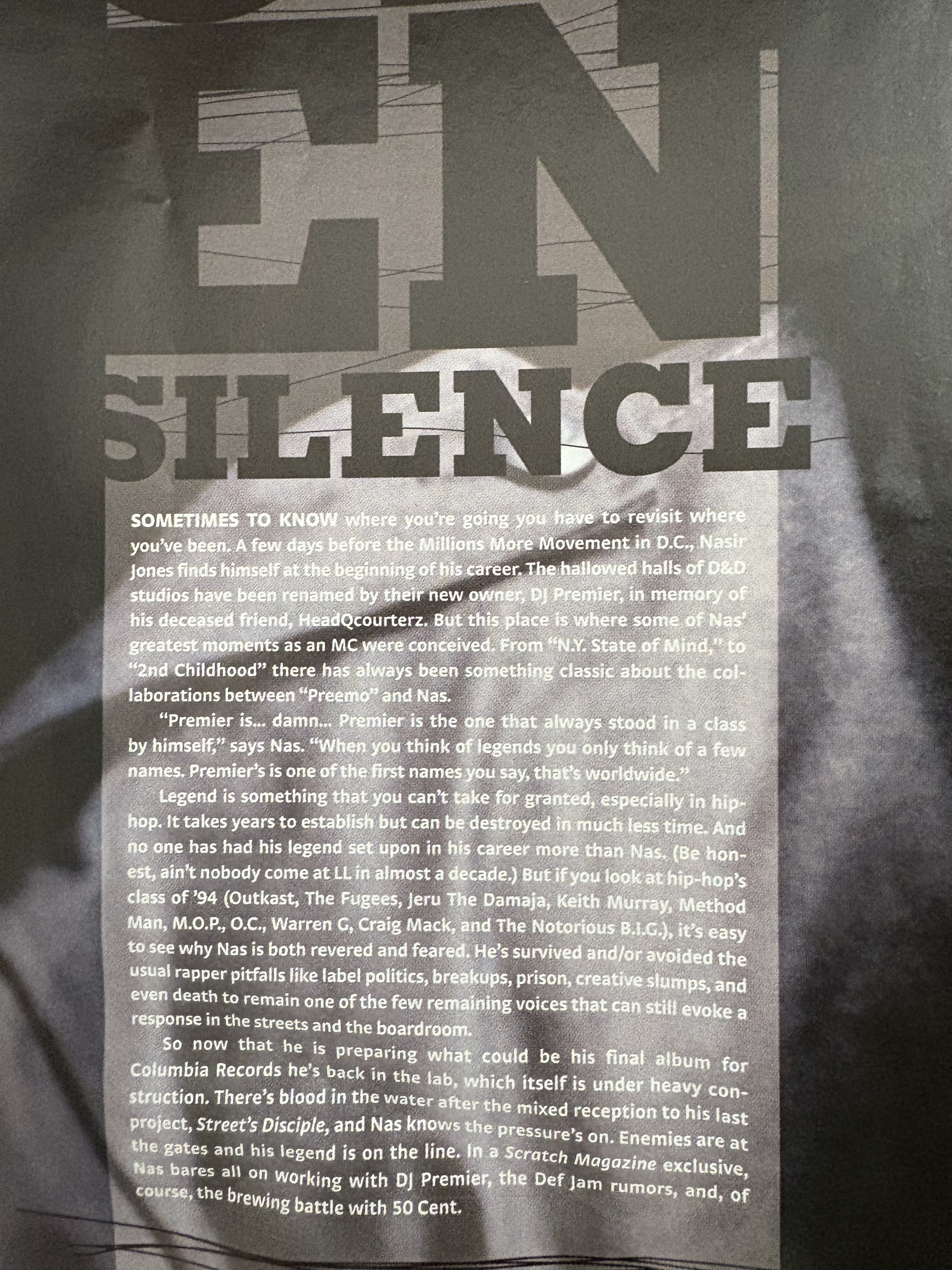
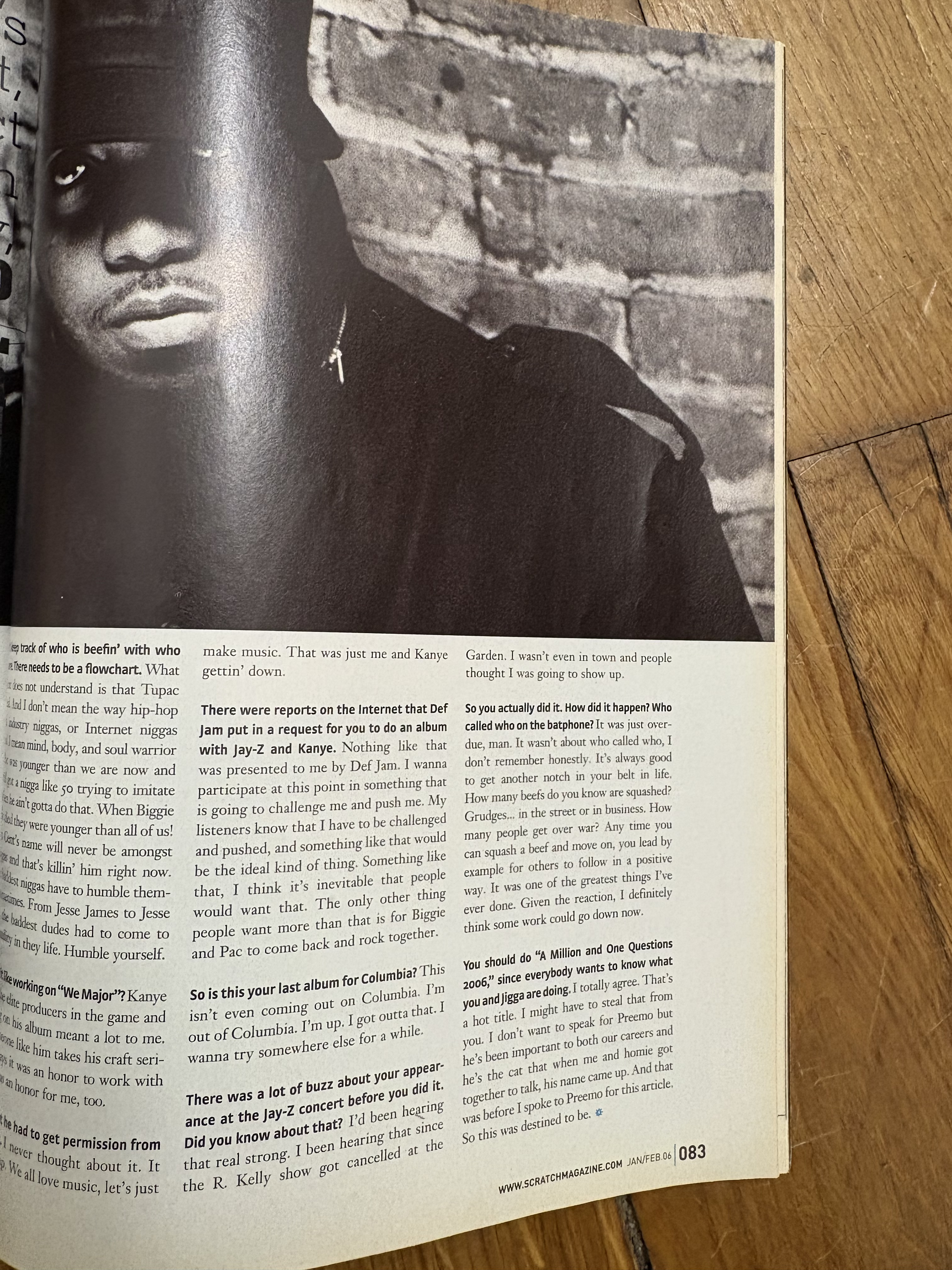
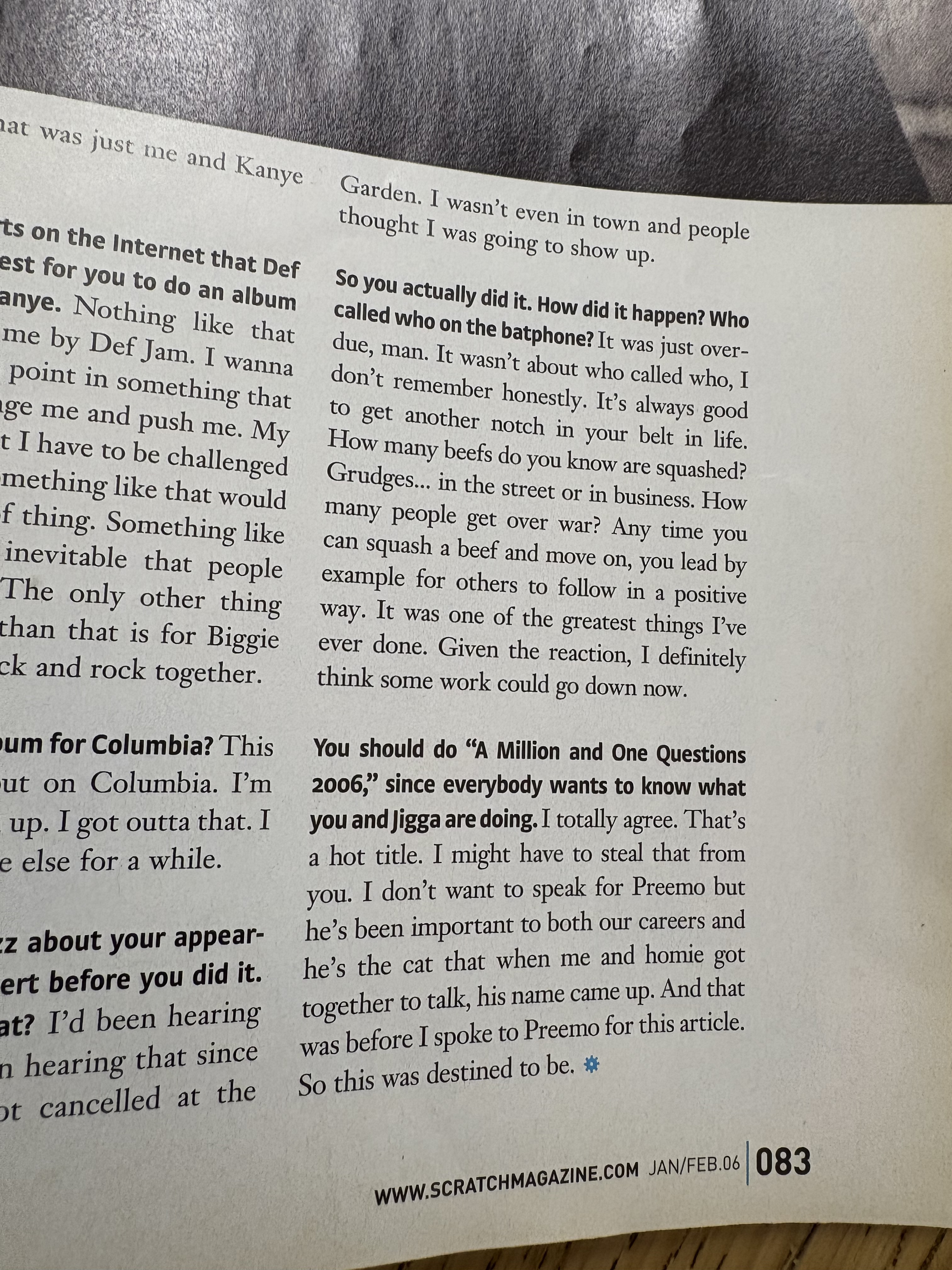
In the introduction by Jerry L. Barrow Nas is portrayed at a pivotal moment in his career, returning to where it all began. D&D Studios. Nas openly acknowledges DJ Premier as a singular figure in hip-hop, placing him among the few true legends recognized worldwide. That statement is still valid today by the way. Jerry L. Barrow also emphasizes how fragile legacy is in hip-hop, especially for artists of Nas’ generation and give all the impressive list of 94 alumnis : Outkast, The Fugees, Jeru The Damaja, Keith Murray, Method Man, M.O.P., O.C., Warren G, Craig Mack, and The Notorious B.I.G. Wow. We also learn that Nas prepares for his final album for Columbia Records. His eighth album Hip-Hop Is Dead will be released the 19th of December … Without any music by Preemo.
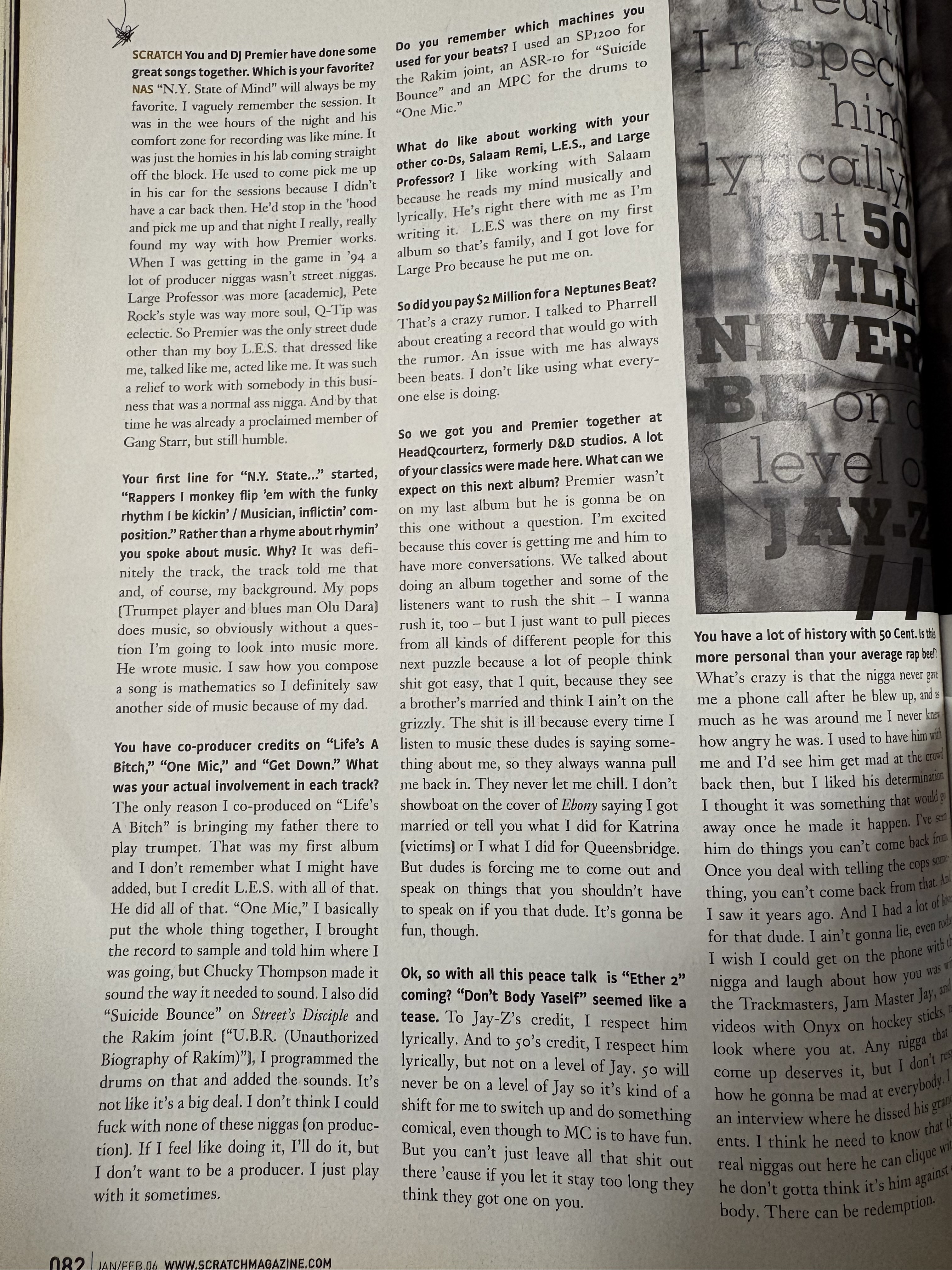
Jerry L. Barrow starts the interview with an obvious but still great question : You and DJ Premier have done some great songs together. Which is your favorite?
“N.Y. State of Mind” will always be my favorite. I vaguely remember the session. It was in the wee hours of the night and his comfort zone for recording was like mine. It was just the homies in his lab coming straight off the block. He used to come pick me up in his car for the sessions because I didn’t have a car back then. He’d stop in the ’hood and pick me up and that night I really, really found my way with how Premier works. When I was getting in the game in ’94 a lot of producer niggas wasn’t street niggas. Large Professor was more [academic], Pete Rock’s style was way more soul, Q-Tip was eclectic. So Premier was the only street dude other than my boy L.E.S. that dressed like me, talked like me, acted like me. It was such a relief to work with somebody in this business that was a normal ass nigga. And by that time he was already a proclaimed member of Gang Starr, but still humble.«
As you can read Mr Jones was willing to talk in that interview so the journalist adress the crazy rumor of that period that Nas was willing to pay 2 millions for a Neptune beat. « That’s a crazy rumor. I talked to Pharrell about creating a record that would go with the rumor. An issue with me has always been beats. » Later in the interview, Nas talks about beefing with 50 Cent and the end of the battle with Jay-Z. Asked who made the first call, Nas smartly dismisses the narrative entirely. “It wasn’t about who called who. I don’t remember honestly.” What matters to him is elsewhere: closure, growth and example. Squashing a beef, whether in the street or in business, is framed as an act of leadership rather than capitulation. “Any time you can squash a beef and move on, you lead by example for others to follow in a positive way.” What’s striking is how Nas places reconciliation on the same axis as artistic evolution.
The last question is also very good : you should do “A Million and One Questions 2006,” since everybody wants to know what you and jigga are doing. But not as goos as the answer ! I totally agree. That’s a hot title. I might have to steal that from you. I don’t want to speak for Preemo but he’s been important to both our careers and he’s the cat that when me and homie got together to talk, his name came up. And that was before I spoke to Preemo for this article » Instead we’ve got the epic Black Republicans, the cool Success, the « meh » BBC and Sorry Not Sorry of DJ Khaled co-produced by the French guy Tarik Azzouz.
Twenty years ago, Scratch Magazine (thanks to Jerry L. Barrow and Brian Coleman) captured more than a pair of interviews. It documented a moment when hip-hop was still dominating the sales and the culture. The absence of a Nas and DJ Premier album wasn’t a failure it was the expression of an industry caught in the chase of first week sales : the exact opposite of Preem and Nas approach. With Light Years finally released, it confirms and reminds us that longevity in hip-hop has less to do with relevance ( what we call now « trending ») than with timing, control, and narrative ownership. This is what revisiting hip-hop journalism twenty years later allows us to see.

Laisser un commentaire