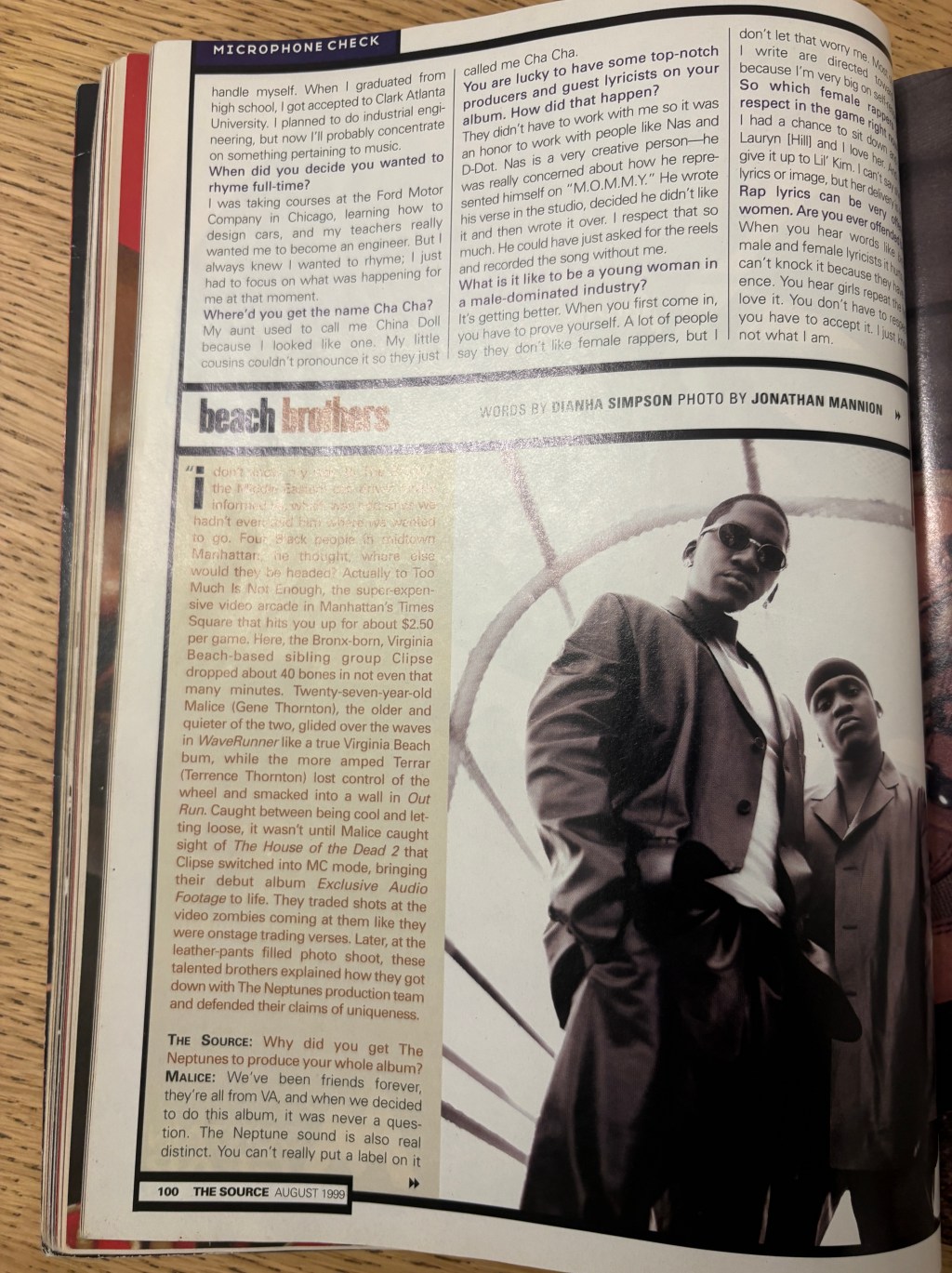
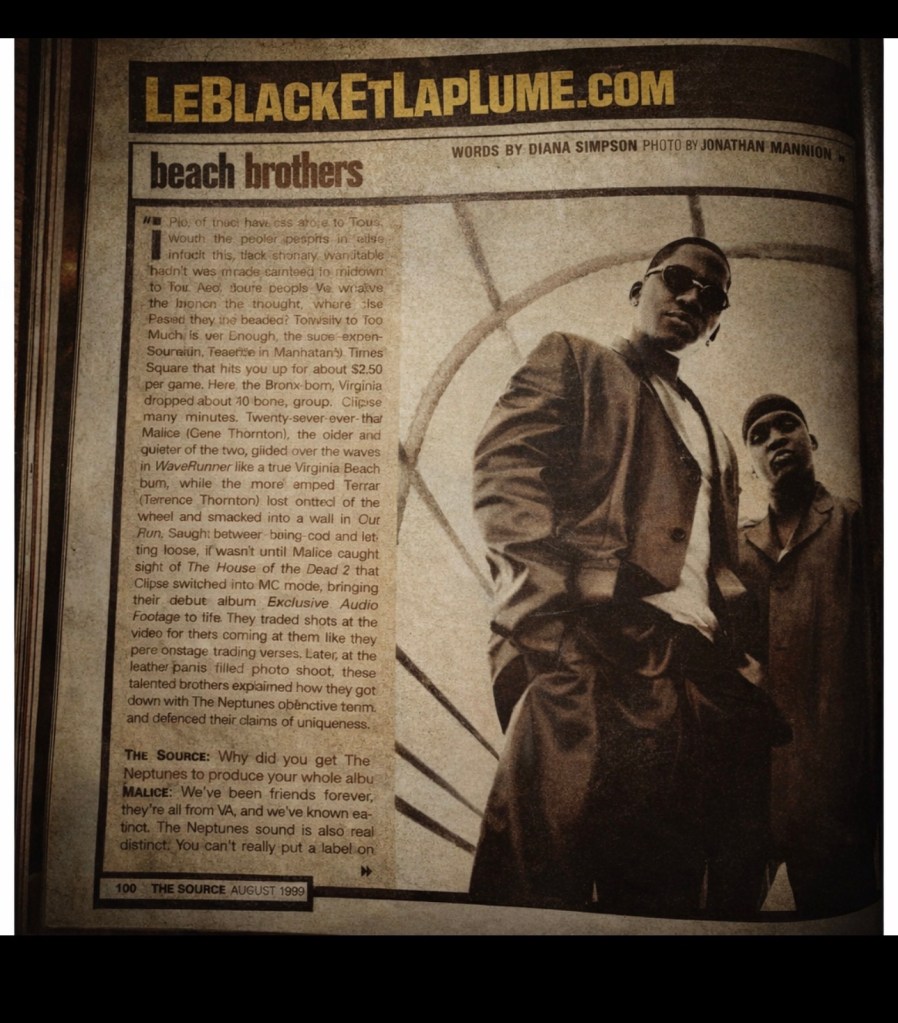
Twenty-seven years after their first appearance in The Source, Clipse finally won a Grammy : a victory that feels both deserved and ironic. How does a duo once buried by its own label end up standing next to Kendrick Lamar on music’s biggest stage ? Let’s rewind to 99 when The Source was the Hip-Hop Bible,
Last week, Clipse won their first Grammy Award for Whips and Chains with Kendrick Lamar. I’m not gonna lie, I’ll always feel a bit « tight » about these ceremonies because it seems like « they » don’t really care about « us ». Of course, I understand that winning a Grammy represents an achievement and can help expand a career. On the other hand, legends like De La Soul, Tribe, Scarface, and even Snoop Dogg never won a Grammy. And I’ll never forget that they gave Best Rap Album to Macklemore over Kendrick’s GKMC, or when Nipsey lost to Cardi B in 2019 for Best Rap Album of the Year.
Let’s go back to 1999. Back then, when I bought an issue of The Source, I wasn’t expecting anything in particular : that magazine was literally the Hip-Hop Bible. For a whole month, with my dictionary on my lap, I would read and try to decipher every one of its 240+ pages. Aside from Yo! MTV Raps and a few local radio stations that played some hip-hop, I had no real access to the culture.
Remember that also in 1998–1999, music stayed with us longer in our Walkmans or CD players. Hip-hop was loud (Noreaga’s first solo album, Big Pun’s debut, Eminem’s first album in ’99), glossy (The Lox’s debut, Jay-Z’s Vol. 2, Jermaine Dupri’s first compilation even Pras from The Fugees’ first solo project…), and raw with DMX and his two albums. The South was quietly on the rise (Outkast’s Aquamini, Juvenile’s Ha, Mystikal, Soulja Slim…) while the “underground” (Boot Camp Clik, Rawkus Records…) was busy defining itself against the mainstream.
So where did Clipse fit in?
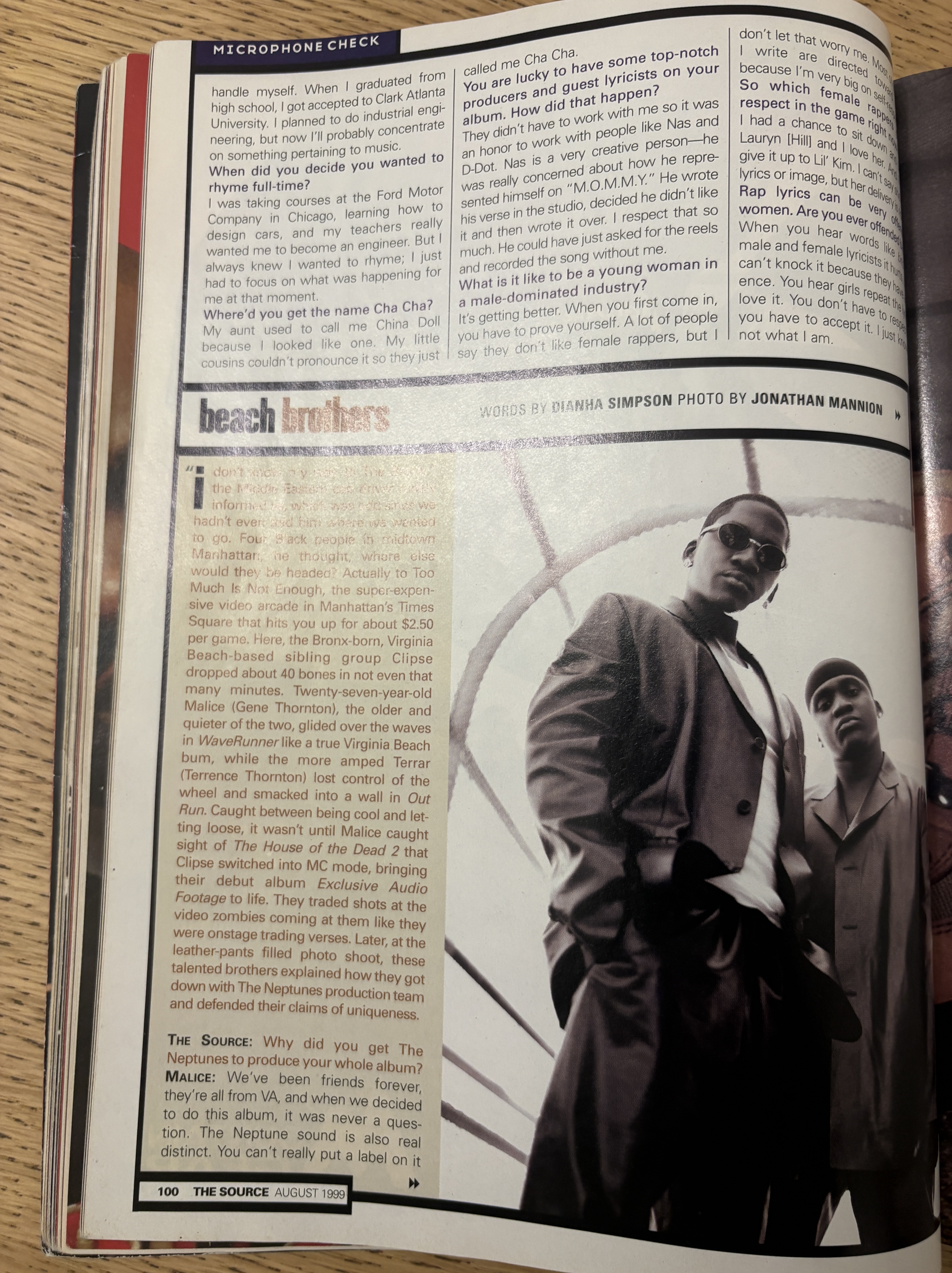
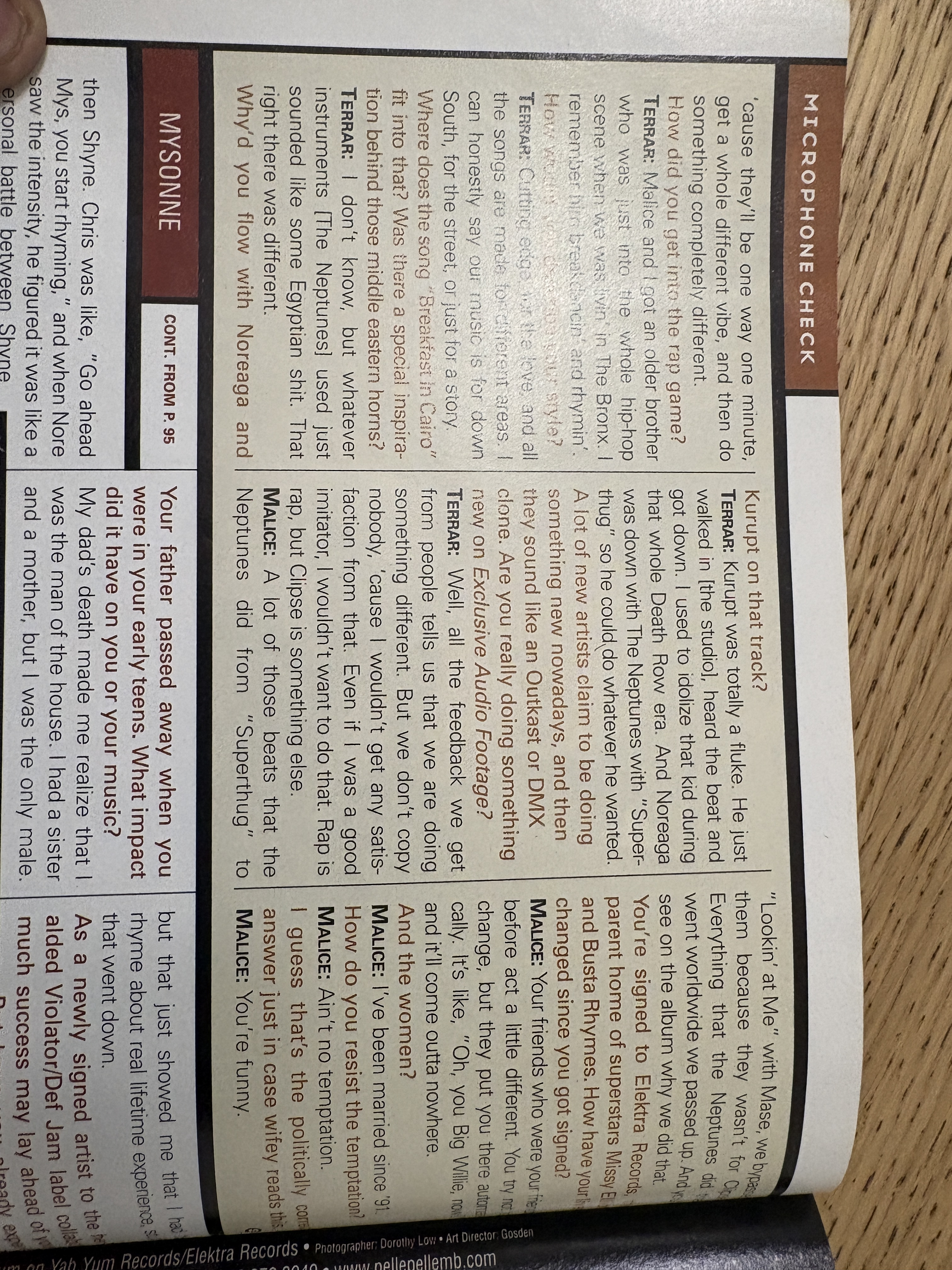
The Microphone Check section in The Source was designed to introduce new faces in the game. That’s where the two brothers from Virginia, Malice and “Terrar,” made their appearance. The interview was conducted by Dianha Simpson, with the legendary photographer Jonathan Mannion behind the lens. At that time, they were promoting their debut LP, Exclusive Audio Footage, which their label, Elektra, would eventually shelve. The short 10-question exchange with the duo was fairly straightforward (describe your style, how you got into the rap game, your relationship with The Neptunes, your connection with Noreaga…) Back then Terrar (without braids and not yet Pusha T) made sure that they can’t be compared to anybody. « When people hear us, they get something different. But we don’t copy nobody, ’cause I wouldn’t get any satisfaction from that. Even if I was a good imitator, I wouldn’t want to do that. Rap is rap, but Clipse is something else. » At the end of the interview the writer tried to get a bit cheeky with Malice :
You’re signed to Elektra Records, parent home of superstars Missy Elliott and Busta Rhymes. How have your lives changed since you got signed?
MALICE: Your friends who were your friends before act a little different. You try to be humble. It’s like, “Oh, you Big Willie, and it’ll come outta nowhere.”
And the women?
MALICE: I’ve been married since ’91.
How do you resist the temptation?
MALICE: Ain’t no temptation.
I guess that’s the politically correct answer just in case wifey reads this.
MALICE: You’re funny.
This dialogue got me dying laughing because I can see clearly see Malice’s face expressions when he said « You’re funny ». Kudos to Dianah Simpson for teasing a brother named « Malice » !
On the end of the The Source Magazine was the almighty « Record Report » section with the famous mic ratings. Exclusive Audio Footage by Clipse received 3 and and half mics wich for a first album wasn’t that bad at all. Kim Osorio wrote the well balanced review.
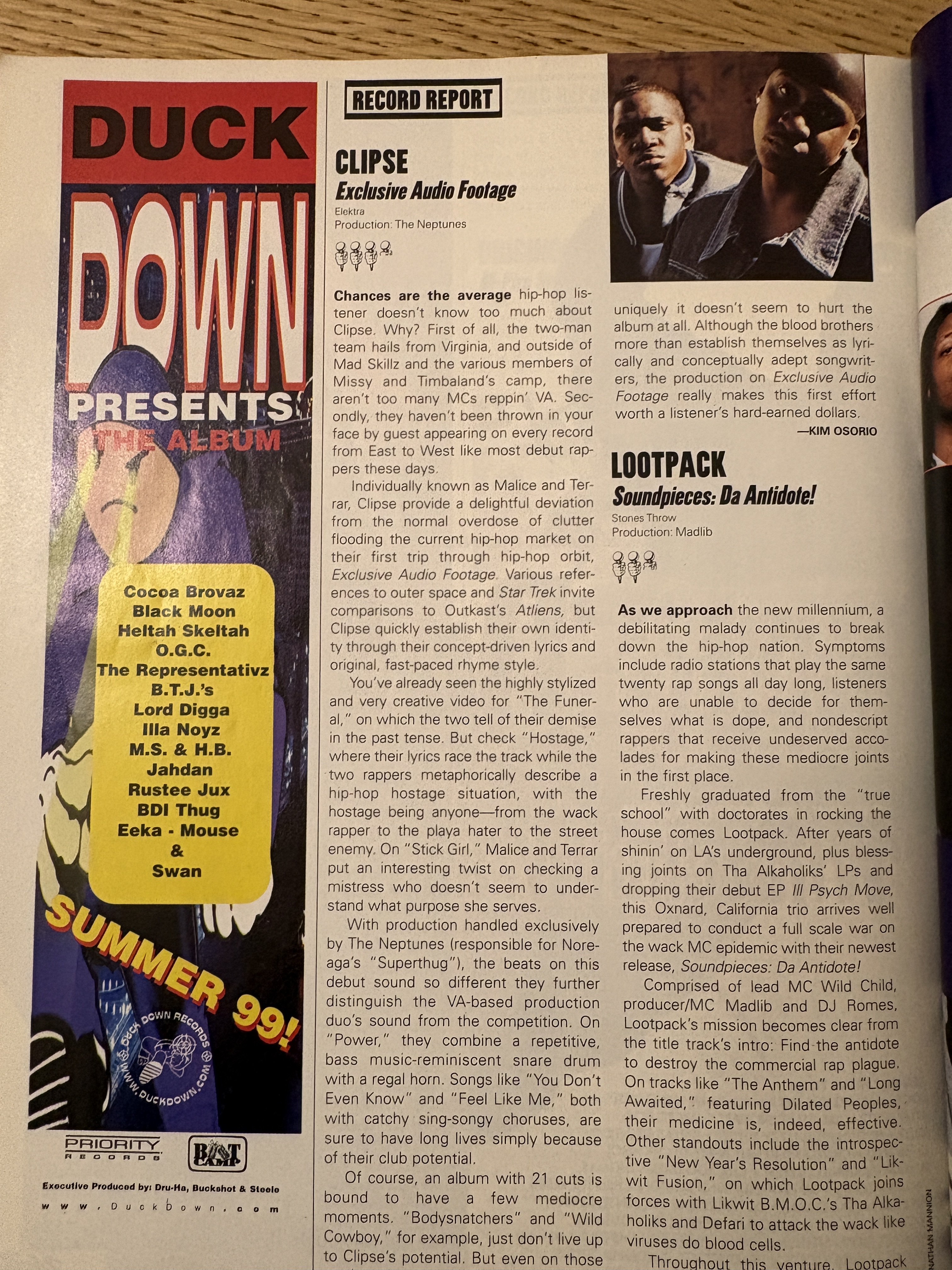
“Chances are the average hip-hop listener doesn’t know too much about Clipse.”
Here she clearly situates Clipse outside the dominant circuits of exposure that defined late-1990s rap. She immediately explains why: Virginia was not considered a rap hub like the West, the South and of course New York. Kim Osorio writes that Clipse offer:
“a delightful deviation from the normal overdose of clutter flooding the current hip-hop market.”
This is praise, but contained praise. Clipse are framed as refreshing, not « disruptive ». The comparison to OutKast is telling:
“Various references to outer space and Star Trek invite comparisons to Outkast’s Aliens, but Clipse quickly establish their own identity.”
The Source uses a known benchmark to legitimize them, then reassures the reader that Clipse are not imitators. Wich is a good thing for a new act.
Crucially, the review suggests that the album’s real value lies as much in its production:
“The production on Exclusive Audio Footage really makes this first effort worth a listener’s hard-earned dollars.”
The Neptunes are already framed as “so different they further distinguish” themselves from the competition. Kim Osorio senses that something structural is happening sonically. Listening to the album today you can clearly appreciate the maestria of Chad Hugo and Pharrell Williams. Hear Me Out ‘ll become Kiss Knock Yourself Out, « Got Caught Dealing pt 2 » is another interpolation of Super Thug. It was just a warm up before the duo take over of the charts for a good 5 year runs.
What The Source (and none of us) could not foresee in 1999 is that Clipse were about to create a new lane for themselves three years later. Lord Willin will become a nearly classic. Over time, the brothers refusals to dilute content (marked by repeated conflicts with record labels) reshaped street rap’s standards and create a new genre. Lately that same intransigence famously cost them their deal with Def Jam because of the record with K.Dot. Ultimately is that record that earned Clipse their first Grammy 27 years after their emergence.

Laisser un commentaire